How to Choose a Website Development Company in India in 2026
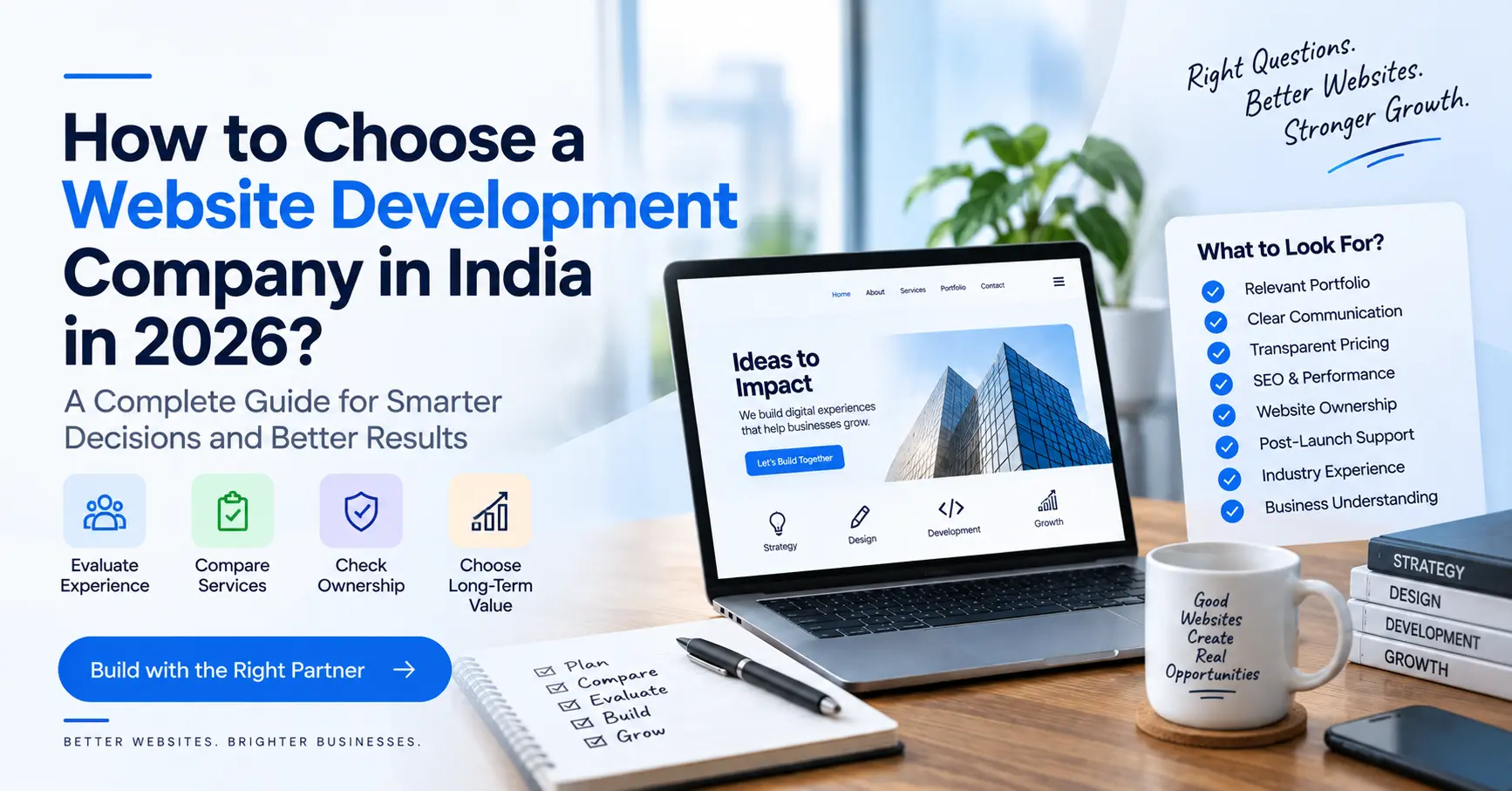
How to Choose a Website Development Company in India in 2026
Choosing a website development company is not simply about finding someone who can build a website.
The harder question is:
Can they build the right website for your business?
There are thousands of freelancers, studios, and agencies offering website development in India. Their prices, processes, technologies, and quality can vary significantly.
Two companies can quote very different prices for what appears to be the same website.
That does not automatically mean the cheaper company is better.
The real difference can be in design, performance, SEO, functionality, ownership, support, security, and the process used to build the website.
If you are planning to hire a website developer or web development agency in India in 2026, this guide will help you compare your options before signing a contract.
First: Decide What You Actually Need
Before contacting a website development company, define what you want the website to achieve.
Do not start with:
"I need a website. How much will it cost?"
Start with:
"I need a website that generates enquiries for my business."
Or:
"I need an online store where customers can purchase my products."
Or:
"I need a professional website that helps customers discover and trust my business."
The goal changes the website.
For example, if you only need a focused campaign page, a landing page may be enough.
If you want a long-term online presence with multiple services and content, a complete website is usually more appropriate.
You can read our detailed comparison:
Website vs Landing Page: Which Does Your Business Need in 2026?
1. Look at Live Websites, Not Just Portfolio Images
A portfolio screenshot can look impressive.
It does not tell you everything.
Before hiring a website development company, ask for live websites they have actually built.
Open those websites on:
- Mobile
- Desktop
- Different browsers
Then check:
- Does the website load quickly?
- Does the navigation work?
- Is the design responsive?
- Are buttons easy to use?
- Does the content make sense?
- Are forms working?
- Does the website look maintained?
A live website gives you much more evidence than a screenshot.
Also ask what role the company played in each project.
Did they design it?
Did they develop it?
Did they provide SEO?
Did they only customize a template?
These distinctions matter.
2. Check Whether They Understand Your Business
A good website development company should ask questions before giving you a final recommendation.
They should want to understand:
- Your target customers
- Your products or services
- Your competitors
- Your business goals
- Your marketing channels
- Your current website
- Your desired features
- Your timeline
- Your budget
If the first conversation is only:
"How many pages do you want?"
that is not enough.
A website is a business tool.
The agency should understand what the website needs to accomplish before deciding how it should be built.
3. Compare the Scope, Not Just the Price
This is one of the biggest mistakes businesses make.
Imagine three companies quote:
₹25,000
₹60,000
₹1,20,000
You cannot decide which is better simply by comparing those numbers.
Ask what each quote includes.
For example:
| Item | Agency A | Agency B | Agency C |
|---|---|---|---|
| Custom design | No | Yes | Yes |
| Mobile responsive | Yes | Yes | Yes |
| SEO setup | Basic | Yes | Yes |
| Analytics | No | Yes | Yes |
| CMS | Yes | Yes | Yes |
| Copywriting | No | No | Yes |
| Integrations | Limited | Several | Custom |
| Maintenance | No | 1 month | 6 months |
| Support | Limited | Yes | Yes |
Now the prices become easier to understand.
A higher price is not automatically justified.
A lower price is not automatically a bargain.
Compare deliverables before comparing prices.
4. Ask Who Actually Owns the Website
This is one of the most important questions to ask.
When the project is complete, who owns:
- Domain
- Hosting account
- Website files
- Source code
- Design files
- Database
- Analytics account
- Google Search Console
- Business email
- Third-party subscriptions
Ideally, your business should maintain control over its critical digital assets.
Be especially careful with arrangements where:
"The website is hosted on our account and cannot be moved."
Your website should not become a hostage to the company that built it.
Get ownership and access terms in writing before development begins.
5. Ask About the Technology
You do not necessarily need to understand every programming language.
But you should understand what you are paying for.
Ask:
- What platform will be used?
- Why is that platform appropriate?
- Is the website custom-built or template-based?
- Can the website be extended later?
- Can another developer maintain it?
- Is the technology documented?
There is no universally "best" technology.
A simple business website does not necessarily need a complicated custom application.
At the same time, a business with complex requirements should not be forced into a platform that cannot support them.
The technology should follow the business requirement.
6. Make Sure SEO Is Considered From the Beginning
SEO should not be treated as something you add after the website is finished.
The website structure affects search visibility.
Important foundations can include:
- Search-friendly URLs
- Page titles
- Heading structure
- Internal links
- Image optimization
- Mobile usability
- Crawlability
- XML sitemap
- Canonical URLs
- Structured data where appropriate
- Page performance
Google's current documentation continues to emphasize useful content, crawlable pages, descriptive links, and sound technical foundations.
If organic search matters to your business, ask the developer:
"What SEO foundations are included in the website development?"
Do not accept the answer:
"SEO can be added later."
Some SEO work can be done later.
But the website architecture should not make SEO unnecessarily difficult.
For more on building online visibility, read:
How to Get Your Business Found on Google & AI Search in 2026
7. Check Website Speed and Performance
A visually impressive website can still be a bad website if it is slow.
Check the agency's existing work.
Test their portfolio websites on mobile.
Look at:
- Loading speed
- Image sizes
- Layout stability
- Mobile responsiveness
- Interaction performance
Do not judge an agency solely by a single PageSpeed score.
Performance depends on many factors, including hosting, third-party scripts, images, content, and configuration.
But consistently slow client websites should still be treated as a warning sign.
8. Ask How the Website Will Generate Leads
A website should not simply look professional.
It should help visitors take the next step.
Depending on your business, that might be:
- Call
- Contact form
- Quote request
- Booking
- Product purchase
- Consultation
- Newsletter signup
Ask the agency:
"How will this website turn visitors into customers?"
That question separates a design-only project from a business-focused website project.
9. Understand the Difference Between Website and Landing Page
Not every marketing campaign needs a complete website.
Sometimes a dedicated landing page is better.
For example, if you are running an advertising campaign for one service, a focused landing page can reduce distractions and direct visitors toward one action.
But if your business has multiple services and wants long-term search visibility, a complete website provides more room to grow.
Our Website vs Landing Page guide explains when each approach makes sense.
10. Check Their Post-Launch Support
The website launch is not necessarily the end of the project.
Ask what happens afterward.
For example:
- Who fixes bugs?
- How long is support included?
- Are content changes included?
- Who handles backups?
- Who handles security updates?
- What happens if the website goes down?
- How much does ongoing maintenance cost?
Get these terms in writing.
"Support available" is not a useful contract term unless you know what it means.
11. Ask for a Clear Timeline
A professional project should have a realistic delivery process.
Depending on the project, this might include:
- Discovery
- Requirements
- Sitemap
- Wireframes
- UI/UX design
- Development
- Content integration
- Testing
- SEO setup
- Launch
- Post-launch monitoring
Ask which milestones you will review.
You should not discover what the website looks like for the first time on launch day.
12. Understand Revision Limits
"Unlimited revisions" sounds attractive.
But it can create problems if nobody defines what a revision actually means.
Ask:
- How many design revisions are included?
- What counts as a new feature?
- What happens when requirements change?
- How are additional requests priced?
A clear change-request process protects both the business and the development team.
13. Ask About Mobile Experience
Your website should not be designed only for a laptop.
Check the agency's existing websites on your phone.
Look at:
- Navigation
- Text size
- Buttons
- Forms
- Images
- Menus
- Page speed
- Contact options
A mobile-friendly website is not simply a smaller desktop website.
The experience needs to work properly on smaller screens.
14. If You Are a Local Business, Ask About Local SEO
If customers search for your business based on location, local SEO matters.
For example:
- Website developer in Vadodara
- SEO agency in Ahmedabad
- Digital marketing agency near me
- Restaurant in Surat
Your website should clearly communicate:
- What your business does
- Where you operate
- Which services you provide
- How customers can contact you
Your website should also work alongside your Google Business Profile.
Google says local results are primarily influenced by relevance, distance, and prominence.
Read our Google Maps and Local SEO Guide for a deeper explanation.
15. Look for Evidence, Not Promises
Be cautious when an agency says:
- "We guarantee #1 on Google."
- "You will get thousands of visitors."
- "Your website will definitely generate 100 leads."
- "We have a secret SEO strategy."
- "Your website will rank in seven days."
No legitimate agency can guarantee Google's organic ranking position for every query.
Instead, ask for evidence:
- Live projects
- Case studies
- Process documentation
- Client testimonials
- Performance examples
- Search visibility examples
- Clear deliverables
The best sales pitch is evidence.
Website Development Cost in India
Website prices vary widely because websites vary widely.
A simple business website is not the same product as an e-commerce store or custom web application.
Factors that can affect the cost include:
- Number of pages
- Custom design
- Content
- SEO
- Integrations
- E-commerce functionality
- Booking systems
- User accounts
- Custom dashboards
- Development technology
- Hosting
- Maintenance
Before comparing prices, read:
How Much Does a Website Cost in India in 2026?
The goal should not be finding the cheapest developer.
The goal should be finding the right solution for your requirements.
Red Flags When Hiring a Website Development Company
Walk away or investigate further if a company:
1. Cannot show live work
Screenshots are not enough.
2. Gives a quote without understanding the project
If they don't know what you're building, how can the quote be accurate?
3. Refuses to clarify ownership
You should know who controls your domain, hosting, code, and accounts.
4. Promises guaranteed Google rankings
Google does not sell organic rankings.
5. Has no post-launch support plan
Ask what happens when something breaks.
6. Gives an extremely vague proposal
A proposal should clearly explain what you are receiving.
7. Focuses entirely on design
Design matters.
But so do performance, usability, SEO, conversion, security, and maintenance.
A Simple 10-Point Checklist
Before choosing a website development company, ask:
- Can they show live websites?
- Have they built something similar to your requirements?
- Do they understand your business goals?
- Is the project scope written clearly?
- Is pricing transparent?
- Will you control your domain and hosting?
- Will you receive the necessary website access?
- Is SEO included at the appropriate level?
- Is mobile performance considered?
- Is post-launch support clearly defined?
If you cannot get clear answers to these questions, do not rush into signing the agreement.
Final Thoughts
Choosing a website development company in India is not about finding the company with the lowest quote or the most impressive homepage.
It is about finding a team that understands what your business needs the website to accomplish.
Look at:
Business understanding.
Real work.
Technical quality.
SEO foundations.
Performance.
Ownership.
Communication.
Support.
Clear pricing.
A website is not finished when the homepage goes live.
It needs to be useful to customers, discoverable through search, easy to maintain, and capable of supporting your business as it grows.
If you are planning a new website, redesign, landing page, or web application, Arctis Digital can help you evaluate the right approach before development begins.