How to Rank Your Business on Google Maps in 2026: Local SEO Guide
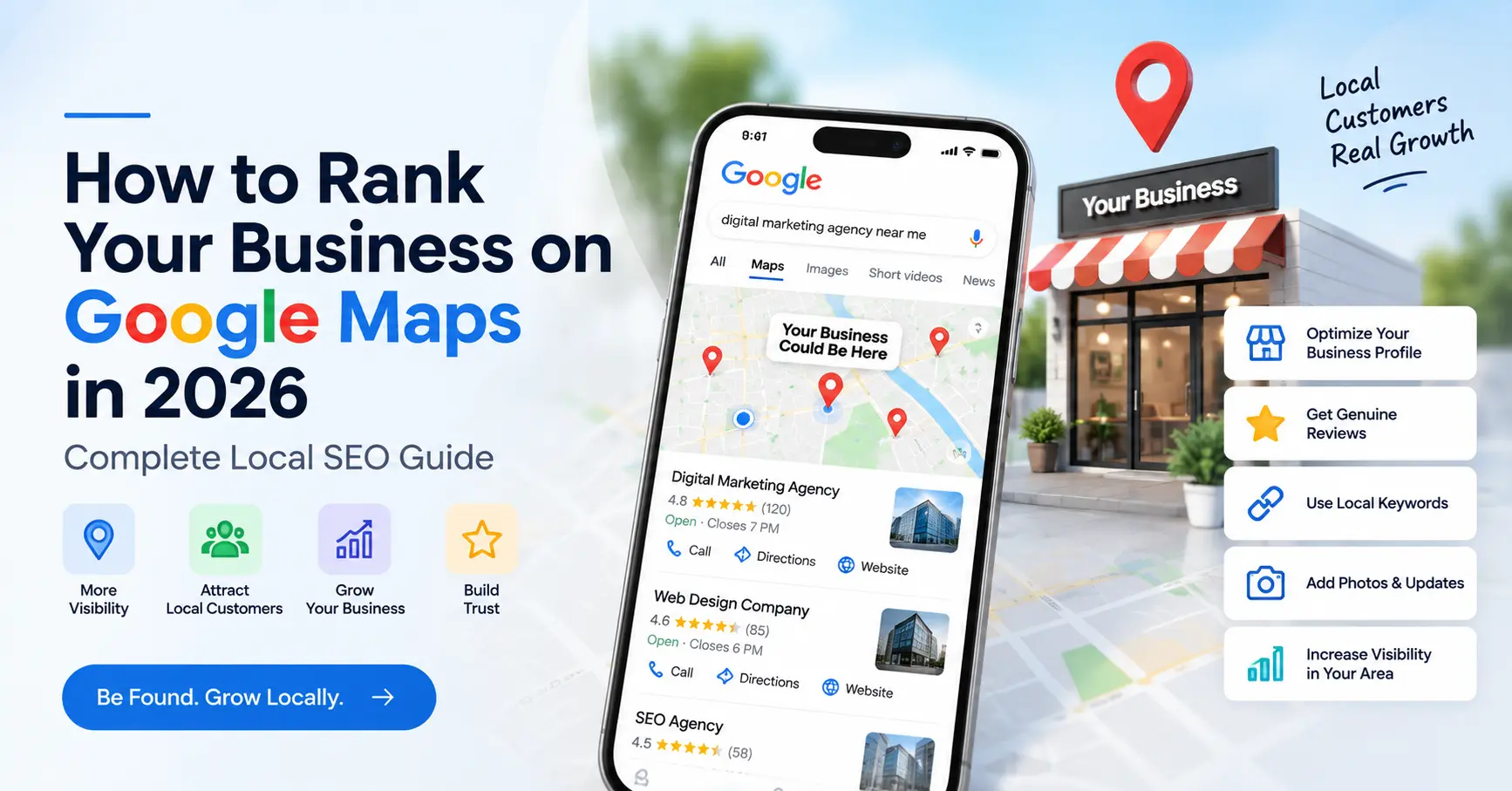
How to Rank Your Business on Google Maps in 2026: Local SEO Guide
When someone searches for a business near them, Google does not simply show the businesses with the biggest advertising budgets.
Google uses information about businesses to determine which local results are most relevant to the searcher.
For a small business, this creates a major opportunity.
A well-optimized Google Business Profile, a useful website, strong customer reviews, and consistent business information can help your business become more visible when people search for services in your area.
In this guide, we explain how local SEO works in 2026 and what businesses can do to improve their visibility on Google Maps and Google Search.
What Is Local SEO?
Local SEO is the process of improving a business's online visibility for searches related to a specific location.
For example:
- Digital marketing agency near me
- Web development company in Vadodara
- Best salon in Ahmedabad
- Dentist near me
- Restaurant in Surat
- CA in Mumbai
Unlike traditional SEO, local SEO focuses heavily on location and local customer intent.
The goal is simple:
Help people in your service area discover your business when they are looking for what you offer.
How Does Google Local Ranking Work?
Google states that local search results are primarily based on three factors:
- Relevance
- Distance
- Prominence
Relevance
Relevance is how closely your business matches what someone is searching for.
If someone searches for:
"website development company"
Google needs to understand which businesses actually provide website development.
Your Business Profile should therefore accurately describe:
- What your business does
- Which services you provide
- Your business category
- Your service areas
- Your website
- Your contact information
Complete and accurate information helps Google understand your business.
Distance
Distance refers to how far a business is from the person searching or from the location included in the search.
For example:
"web designer near me"
and
"web designer in Vadodara"
can produce different local results.
You cannot completely control distance.
A business physically closer to the searcher may have an advantage for a particular local query.
Prominence
Prominence refers to how well-known a business is.
Google can use information from across the web to understand the prominence of a business.
This can include things such as:
- Reviews
- Links from other websites
- Articles
- Business directories
- General search visibility
This is why local SEO is not just about filling out your Google Business Profile once.
Your wider online presence matters too.
1. Claim and Verify Your Google Business Profile
Your Google Business Profile is one of the most important foundations of local SEO.
If you operate an eligible local business, make sure your profile is claimed and verified.
Then complete as much relevant information as possible.
Check:
- Business name
- Primary category
- Address
- Service area
- Phone number
- Website
- Business hours
- Special hours
- Business description
- Services
- Attributes
Do not add information simply because you think it contains more keywords.
The information should accurately describe your real business.
2. Choose the Right Business Category
Your business category helps Google understand what your business is.
For example, a company providing website development and digital marketing should select the category that most accurately represents its primary business.
Do not choose a category simply because you think it has more searches.
Choose the category that best describes what your business actually does.
You can also add relevant additional categories where they genuinely apply.
3. Keep Your Business Information Consistent
Your business information should be consistent across your website and relevant online listings.
Pay attention to:
- Business name
- Address
- Phone number
- Website
- Service information
If different websites contain conflicting information, it can make your online presence less clear.
Create a consistent business identity across the web.
4. Get Genuine Customer Reviews
Reviews are important for both customers and local visibility.
A potential customer comparing two businesses will often look at:
- Rating
- Number of reviews
- Recent reviews
- Customer experiences
- Business responses
Ask genuine customers to leave honest reviews after completing a service.
Do not buy fake reviews.
Do not create reviews for your own business.
Do not offer misleading incentives in exchange for positive reviews.
A smaller number of genuine reviews is far more useful than a collection of suspicious ones.
5. Respond to Your Reviews
Getting reviews is not the end of the process.
Respond to them.
Thank customers who leave positive feedback.
For negative reviews, respond professionally and try to address the actual concern.
Your responses also show potential customers that your business is active and pays attention to customer feedback.
6. Add High-Quality Photos and Videos
Visual information can help customers understand your business before contacting you.
Depending on your business, you can add:
- Office photos
- Store photos
- Product photos
- Project photos
- Team photos
- Work samples
- Before-and-after images
- Short videos
Avoid uploading random stock images that do not represent your actual business.
Real business photos provide much more useful information.
7. Build a Strong Local SEO Website
Your Google Business Profile should not work alone.
Your website should reinforce the same information.
Your website should clearly explain:
- What you do
- Who you serve
- Where you operate
- What services you provide
- How customers can contact you
For example, a digital agency targeting local businesses could create dedicated service pages such as:
- Website Development
- SEO Services
- Digital Marketing
- E-commerce Development
- Social Media Marketing
If you genuinely serve different locations, location-specific pages can also be useful when they contain unique and valuable information.
Do not create dozens of nearly identical pages simply by replacing the city name.
8. Target Local Search Keywords Naturally
Local keywords can help you understand what customers are looking for.
Examples include:
- Website development company in Vadodara
- Web design company in Ahmedabad
- SEO services in Gujarat
- Digital marketing agency near me
- Website developer for small business
But do not repeat the same keyword dozens of times.
Use natural language.
Instead of writing:
"Best web development company in Vadodara offers web development in Vadodara for businesses in Vadodara."
write naturally:
"We help businesses in Vadodara build fast, responsive websites designed around their business goals."
The second version is better for humans and still communicates the relevant topic.
9. Create Location-Relevant Content
Your blog can support your local SEO strategy.
For example, a web development company could publish:
- How Much Does a Website Cost in Vadodara?
- Website Development for Small Businesses in Gujarat
- Local SEO Guide for Businesses in Vadodara
- How to Get Your Business Found on Google
- Website vs Landing Page for Local Businesses
The key is to provide genuinely useful information.
Do not create location pages that contain nothing except a city name and generic marketing text.
10. Build Local Authority
Your website can become more credible when relevant websites mention or link to your business.
Potential sources can include:
- Local business directories
- Industry directories
- Local publications
- Business associations
- Partner websites
- Client websites
- Relevant industry blogs
- Local events and organizations
The important word is relevant.
Buying hundreds of unrelated backlinks is not a local SEO strategy.
Focus on legitimate mentions and relationships.
11. Make Your Website Mobile-Friendly
Local searches frequently happen when people are away from their computers.
That means your website needs to work properly on mobile devices.
Check:
- Text size
- Navigation
- Buttons
- Contact forms
- Page speed
- Images
- Layout
- WhatsApp/contact options
A customer who finds your business on Google Maps should be able to visit your website and quickly understand what you offer.
12. Add Clear Contact Options
Local search is often driven by immediate intent.
Someone searching for a service may want to:
- Call
- Send a WhatsApp message
- Visit the business
- Request a quote
- Book an appointment
- Visit the website
Make these actions easy.
Do not force customers to search through five pages before finding your contact information.
13. Connect Your Website and Google Business Profile
Your website and Business Profile should reinforce each other.
Make sure the website linked from your Business Profile is:
- Working
- Mobile-friendly
- Relevant to the business
- Consistent with your Business Profile
- Easy to navigate
Your website should clearly communicate the same core business information.
Google also uses publicly available information from websites and other sources when compiling information about businesses.
14. Track What Is Actually Working
Do not judge local SEO only by asking:
"Am I number one?"
Local rankings can vary based on factors such as the searcher's location and the query.
Instead, monitor useful business outcomes.
Track:
- Website traffic
- Contact form enquiries
- Phone calls
- WhatsApp enquiries
- Direction requests
- Search impressions
- Search queries
- Reviews
- Leads generated
The purpose of local SEO is not to collect rankings.
The purpose is to generate visibility that can contribute to real business results.
Common Local SEO Mistakes
Avoid these mistakes:
Keyword Stuffing
Repeating "best digital marketing agency in Vadodara" everywhere does not make a website better.
Fake Reviews
Fake reviews can damage trust and create serious problems for your reputation.
Incorrect Business Information
Wrong phone numbers, addresses, hours, or service information can confuse customers.
Duplicate Location Pages
Creating hundreds of almost identical city pages adds little value.
Buying Random Backlinks
More links do not automatically mean better SEO.
Relevance and quality matter.
Ignoring Your Website
A Google Business Profile is important, but your website is still part of your overall online presence.
Never Updating Your Profile
Businesses change.
Services change.
Hours change.
Photos change.
Keep important information current.
Local SEO Checklist for 2026
Use this checklist to review your business:
- Google Business Profile claimed and verified
- Correct primary category
- Relevant additional categories
- Accurate business name
- Accurate contact details
- Correct business hours
- Complete service information
- Service area correctly configured
- High-quality real photos
- Genuine customer reviews
- Professional review responses
- Mobile-friendly website
- Local service pages
- Natural local keywords
- Consistent business information
- Relevant local mentions
- Search Console configured
- Website analytics configured
- Leads and enquiries being tracked
Final Thoughts
Ranking on Google Maps is not about finding one secret keyword or tricking Google's algorithm.
Local visibility comes from building a clear and trustworthy online presence.
Start with the basics:
Complete your Google Business Profile.
Keep your information accurate.
Build genuine customer reviews.
Create a useful website.
Publish relevant local content.
Build legitimate online authority.
Google states that local rankings are primarily influenced by relevance, distance, and prominence, so businesses should focus on making their information accurate and useful rather than looking for shortcuts.
For small businesses, local SEO can become an important part of a broader digital growth strategy.
If customers are already searching for the services you provide, the first question is simple:
Can they find you?
If the answer is no, your digital presence needs work.
Arctis Digital helps businesses build websites, improve their online presence, and create digital strategies designed to help customers discover and connect with their business.