How to Get Your Business Found on Google & AI Search in 2026
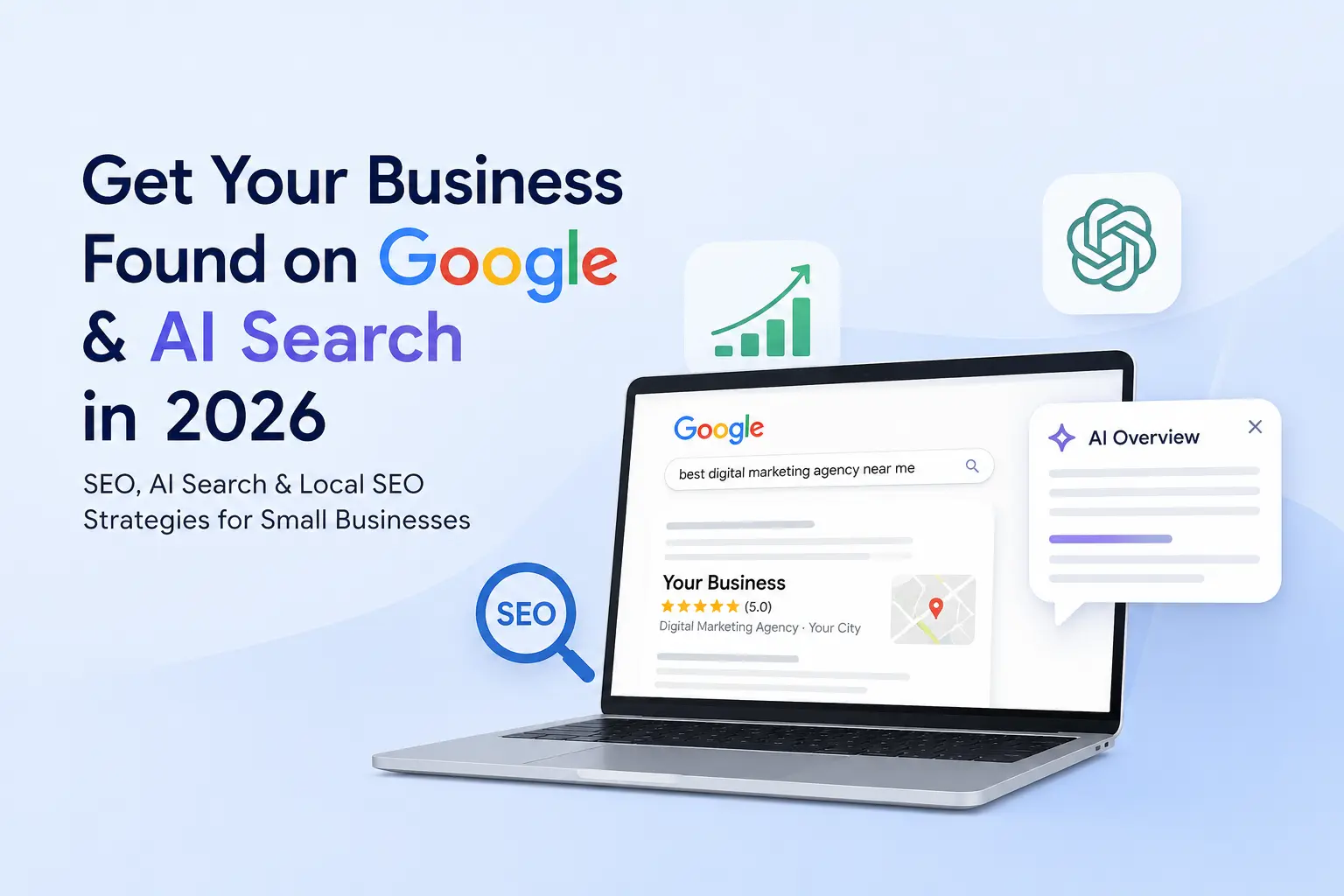
How to Get Your Business Found on Google & AI Search in 2026
If customers cannot find your business online, your competitors are getting the opportunity to win those customers instead.
But search is changing in 2026.
People still use Google to search for businesses, products, and services. At the same time, customers are increasingly using AI-powered search experiences and tools such as ChatGPT, Google AI Overviews, Google AI Mode, Gemini, and Perplexity to discover information and businesses.
That means having a website is no longer enough.
Your website needs to be easy for search engines and AI systems to understand, trustworthy enough to be referenced, and useful enough to answer the questions your customers are actually asking.
In this guide, we explain how businesses can improve their Google SEO, local SEO, website visibility, and AI search visibility in 2026.
Why Search Is Changing in 2026
Traditional search usually gives users a list of websites.
AI-powered search can instead summarize information and provide a direct answer.
For example, instead of searching:
"best digital marketing agency in Ahmedabad"
a potential customer might ask:
"Which digital marketing agencies in Ahmedabad are good for a small business?"
The search experience is becoming more conversational and intent-driven.
Google is also expanding generative AI features in Search. Google Search Central now provides specific guidance for websites appearing in AI-powered search experiences.
This creates a new opportunity for businesses that build strong websites and publish genuinely useful content.
SEO Still Matters
AI search does not mean traditional SEO is dead.
It means businesses need to do SEO properly.
Your website should still have:
- Clear page titles
- Relevant keywords
- Useful and original content
- Descriptive URLs
- Proper heading structure
- Fast page loading
- Mobile-friendly design
- Internal links
- Search-friendly page structure
- Accurate business information
- Relevant backlinks and mentions
- Structured data where appropriate
The important difference is that you should create these elements for users first, rather than trying to fill pages with keywords.
Google's guidance continues to emphasize useful content and warns against creating large amounts of low-value content primarily to manipulate search rankings.
What Is AI Search Optimization?
AI Search Optimization, sometimes discussed as Generative Engine Optimization (GEO) or Answer Engine Optimization (AEO), focuses on making your business information easy for AI-powered search systems to understand and reference.
The objective is not simply to rank for one keyword.
The objective is to become a clear, trustworthy answer to relevant customer questions.
For example, a web design company should not only try to rank for:
"web design company"
It can also create useful content answering questions such as:
- How much does a business website cost?
- What should a small business website include?
- How long does it take to build a website?
- What is the difference between a website and a landing page?
- How does local SEO help a small business?
- How can a business appear on Google?
- How can a local business improve its online visibility?
These questions represent real search intent.
1. Build a Website That Clearly Explains Your Business
One of the most common website mistakes is making the design attractive while failing to explain what the business actually does.
Your homepage should make these things obvious:
What do you offer?
Who do you offer it to?
Where do you operate?
Why should someone choose you?
How can someone contact you?
For example, instead of simply writing:
"Creative digital solutions for modern brands."
a stronger page could clearly explain:
"We provide website design, development, SEO, and digital marketing services for small businesses and startups."
Clear language helps both visitors and search engines understand the business.
2. Target Search Intent, Not Just Keywords
Keywords matter, but search intent matters more.
Someone searching:
"website"
has a very broad intent.
Someone searching:
"website development company for small business in Ahmedabad"
has much stronger commercial intent.
Your website should contain different types of content for different stages of the customer's journey.
Informational searches:
- How much does a website cost?
- How does SEO work?
- What is local SEO?
Commercial searches:
- Best website development company
- SEO agency for small business
- Website design services
Transactional searches:
- Hire a web developer
- Get a business website
- SEO services for my business
Creating content around these different intents gives your website more opportunities to be discovered.
3. Optimize for Local SEO
If you serve customers in a specific city or region, local SEO should be part of your strategy.
Make sure your website clearly communicates:
- Business name
- Service areas
- Physical location when applicable
- Phone number
- Business hours
- Services
- Contact information
You should also maintain accurate business information across relevant online directories and business profiles.
For local businesses, consistency matters.
Your business name, contact details, website, and service information should not contradict each other across the web.
4. Create Content That AI Can Understand
AI search systems need information they can understand and verify.
Avoid writing vague marketing copy throughout your website.
Instead of:
"We deliver next-generation digital transformation solutions."
explain exactly what you do.
For example:
"We design and develop responsive websites for small businesses, startups, agencies, and local service providers."
Specific information is easier for customers to understand and easier for search systems to interpret.
Use clear headings, short sections, lists, examples, FAQs, and direct answers.
5. Answer Real Customer Questions
One of the strongest content strategies for 2026 is simple:
Write about the questions your customers actually ask.
If customers repeatedly ask:
"How much does a website cost?"
create an article answering it.
If they ask:
"Do I need SEO for my small business?"
create an article answering it.
If they ask:
"How long does website development take?"
create an article answering it.
This approach naturally creates relevant long-tail keywords while also providing useful information.
6. Don't Create Hundreds of AI-Generated Articles
Using AI to help research, structure, or draft content can save time.
But publishing hundreds of generic AI-generated articles simply because they contain keywords is a poor SEO strategy.
Google's spam policies specifically address scaled content abuse, including large amounts of low-value content created primarily to manipulate search rankings.
The goal should be:
Useful content + real expertise + original information + clear search intent.
Not:
AI content + keywords + hundreds of pages.
7. Improve Your Website's Technical SEO
Content alone cannot compensate for a technically poor website.
Check your:
- Page speed
- Mobile usability
- HTTPS
- Broken links
- Redirects
- Sitemap
- Robots.txt
- Canonical URLs
- Metadata
- Image optimization
- Structured data
- Internal linking
Your important pages should also be crawlable and indexable.
A technically healthy website gives search engines a much better foundation for understanding your content.
8. Build Trust Around Your Business
Search visibility is not only about what you say about yourself.
Other websites, platforms, customers, and online profiles can help establish your business as a real entity.
Depending on your industry, this can include:
- Customer reviews
- Business directories
- Industry listings
- Relevant backlinks
- Social profiles
- Case studies
- Client testimonials
- Portfolio projects
- Press mentions
- Partnerships
Do not buy random backlinks or create fake mentions.
Focus on genuine business relationships and useful references.
9. Make Your Website Useful Before Making It Promotional
A website that only says:
"Contact us today!"
on every page is not very useful.
Your website should help a visitor make a decision.
Explain:
- What you provide
- Who it is for
- How your process works
- What it costs when appropriate
- What results or outcomes customers can expect
- Common questions
- Examples of previous work
- How to get started
The more clearly your website answers customer questions, the more useful it becomes.
10. Think Beyond Google Rankings
In 2026, your online visibility should not be measured only by one Google ranking.
Look at the bigger picture.
Can customers find your business through:
Google Search?
Google Maps?
Google AI features?
ChatGPT?
Other AI search tools?
Business directories?
Social media?
Referral websites?
The goal is to build a digital presence that consistently communicates who you are, what you do, where you operate, and why customers should trust you.
Final Thoughts
SEO in 2026 is not about stuffing a webpage with as many keywords as possible.
It is about making your business easy to discover, understand, trust, and choose.
A strong strategy combines:
- SEO
- Local SEO
- High-quality website design
- Useful content
- Technical SEO
- Structured information
- Online reputation
- Relevant backlinks
- AI search visibility
Businesses that start building this foundation now can be better positioned as search continues to move from traditional results toward more conversational and AI-powered discovery.
If your website looks good but customers cannot find it, the problem is not just design.
You need a complete digital visibility strategy.