Website vs Landing Page: Which Does Your Business Need in 2026?
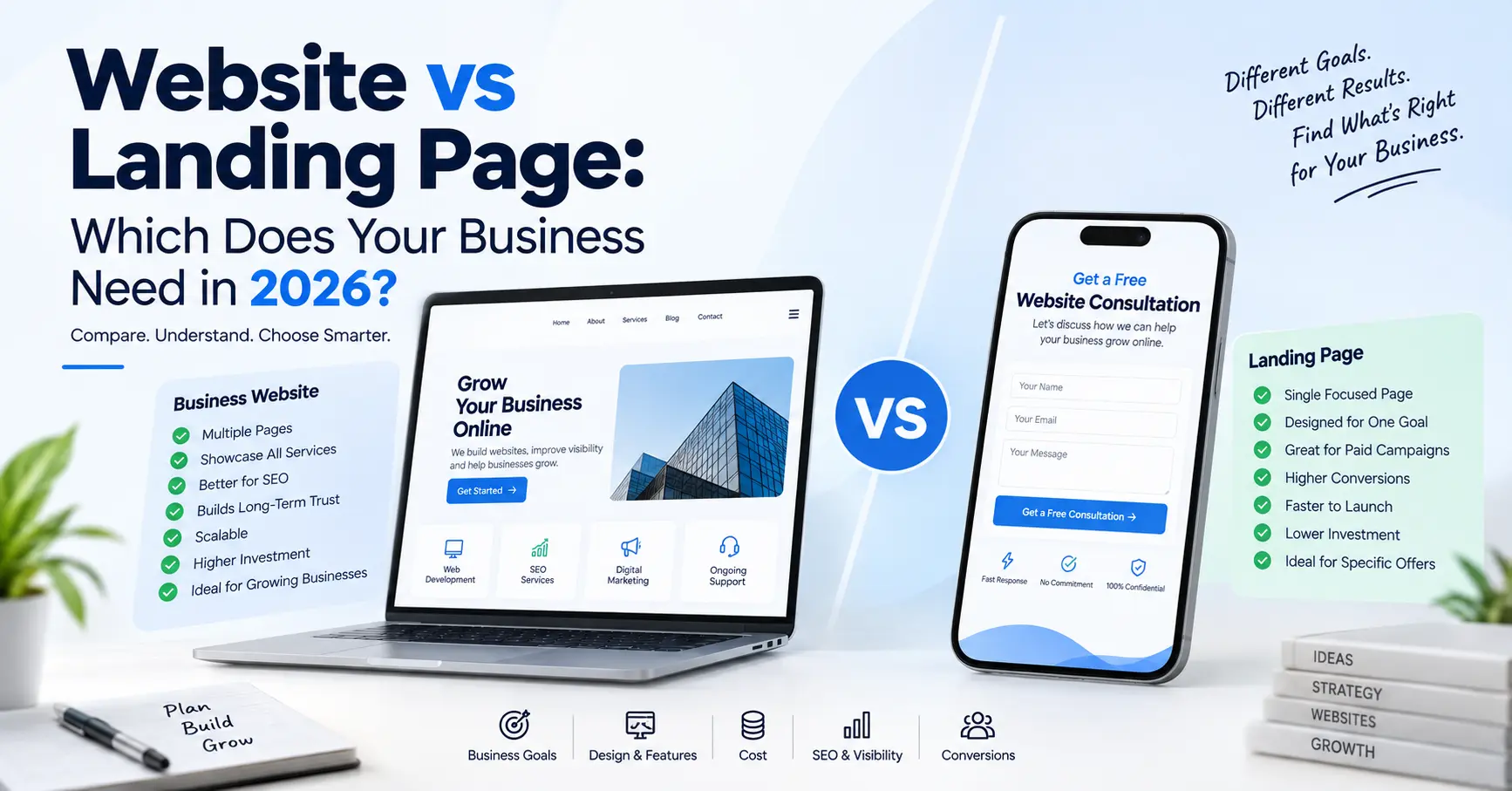
Website vs Landing Page: Which Does Your Business Need in 2026?
If you are starting a business, launching a service, or running an advertising campaign, you may be asking:
"Do I need a full website, or is a landing page enough?"
The answer depends on what you want the page to accomplish.
A landing page is usually focused on one specific goal, such as generating leads, promoting an offer, or collecting enquiries.
A business website is a broader digital presence that can explain your company, services, products, expertise, locations, and other important information.
Neither option is automatically better.
The right choice depends on your business stage, budget, marketing strategy, and long-term goals.
Website vs Landing Page: Quick Comparison
| Feature | Business Website | Landing Page |
|---|---|---|
| Main purpose | Build a complete online presence | Achieve one specific goal |
| Number of pages | Multiple pages | Usually one page |
| SEO opportunities | High | More limited |
| Lead generation | Yes | Excellent for focused campaigns |
| Service information | Multiple services | Usually one offer |
| Blog | Can be included | Usually not necessary |
| Google Search visibility | Stronger long-term potential | Depends heavily on content and intent |
| Paid advertising | Useful | Excellent |
| Scalability | High | Limited |
| Cost | Usually higher | Usually lower |
| Best for | Long-term business presence | Focused campaigns and offers |
What Is a Business Website?
A business website is a collection of pages that represents your company online.
A typical business website may include:
- Home
- About
- Services
- Products
- Portfolio
- Case studies
- Blog
- Contact
- FAQs
The purpose is to give potential customers enough information to understand your business and decide whether they should contact you.
For example, a digital agency may have separate pages for:
- Website Development
- SEO
- Digital Marketing
- Social Media Marketing
- E-commerce Development
This creates more opportunities to explain individual services and target different search intents.
If you are still deciding how much a website could cost, see our guide:
How Much Does a Website Cost in India in 2026?
What Is a Landing Page?
A landing page is a focused page designed around a particular objective.
For example:
Get a Free Website Consultation
The page might contain:
- A headline
- Problem statement
- Benefits
- Service details
- Testimonials
- FAQs
- Call-to-action
- Contact form
Unlike a general business website, a landing page usually minimizes distractions and keeps the visitor focused on one action.
When Should You Choose a Website?
A full website is usually the better option when you want to build a long-term online presence.
1. You Want Customers to Find You on Google
A website gives you more opportunities to create useful pages around different topics and services.
For example, a digital agency could have:
- Website development page
- SEO page
- Local SEO page
- E-commerce development page
- Blog
- Case studies
Each useful page can target a different search intent.
However, simply having more pages does not guarantee better rankings.
Google recommends creating helpful, reliable, people-first content rather than producing pages primarily to attract search traffic.
2. You Offer Multiple Services
If your business provides several services, putting everything on one landing page can make the page difficult to navigate.
A website allows you to create dedicated pages.
For example:
Home
→ Website Development
→ SEO Services
→ Digital Marketing
→ E-commerce Development
→ Contact
This structure makes it easier for visitors to find what they need.
3. You Want to Build Long-Term SEO
A website gives you a stronger foundation for building an SEO content strategy over time.
You can publish:
- Guides
- Tutorials
- Case studies
- FAQs
- Industry articles
- Local SEO content
For example, our guide on how to get your business found on Google and AI search explains how businesses can improve their visibility across traditional and AI-powered search experiences.
Google's current guidance says the same fundamental SEO practices remain relevant for AI features such as AI Overviews and AI Mode. :contentReference[oaicite:1]{index=1}
4. You Want to Build Brand Trust
A complete website gives customers more places to evaluate your business.
They can look at:
- About information
- Services
- Portfolio
- Testimonials
- Case studies
- Blog articles
- Contact details
For a customer considering a significant purchase, this can be more useful than a single promotional page.
When Should You Choose a Landing Page?
A landing page can be the better choice when the objective is narrow.
1. You Are Running a Paid Advertising Campaign
Suppose you are running a Meta or Google Ads campaign for:
"Get a Free Website Consultation."
Sending users to your homepage may not be ideal.
Your homepage could contain many navigation options.
A dedicated landing page can focus entirely on the offer.
The visitor sees:
Headline → Benefits → Proof → CTA
That can create a more focused experience.
2. You Are Launching One Product or Service
A landing page can work well when you have one specific offer.
For example:
- Online course
- Workshop
- Consultation
- Software product
- Event
- Limited-time promotion
- Lead-generation campaign
You don't necessarily need a 20-page website just to promote one specific offer.
3. You Need to Launch Quickly
A landing page can often be designed and launched faster than a complete website because the scope is smaller.
This can be useful when you need to validate an offer before investing in a larger website.
But speed should not mean sacrificing basic quality.
Your landing page should still be:
- Mobile-friendly
- Fast
- Secure
- Clear
- Easy to navigate
- Easy to contact
- Properly tracked
Website vs Landing Page for SEO
This is where the difference becomes important.
A landing page can rank in Google.
But a full website generally gives a business more opportunities to build topical depth.
For example, imagine a web development company.
A single landing page might target:
"Website development company."
A larger website could have separate useful content targeting:
- Website development
- E-commerce development
- Website cost
- Website maintenance
- Small business websites
- Local SEO
- Website design
- Website performance
These pages can support each other through contextual internal links.
Google's documentation specifically recommends using internal links to help users and search engines discover related pages. :contentReference[oaicite:2]{index=2}
Website vs Landing Page for Lead Generation
A common misconception is:
"A website generates leads, while a landing page doesn't."
Both can generate leads.
The difference is the amount of focus.
A website can generate leads through:
- Contact forms
- Service pages
- Phone calls
- Consultation requests
- Product enquiries
A landing page can focus almost entirely on one conversion.
For paid campaigns, that focus can be valuable.
What About Google Maps and Local SEO?
If you operate a local business, your website can support your local search presence.
For example, your website can explain:
- What services you provide
- Where you operate
- Your business information
- Service areas
- Customer questions
- Projects and case studies
This works alongside your Google Business Profile.
Our Google Maps and Local SEO guide explains how relevance, distance, and prominence influence local visibility and what businesses can do to improve their local presence.
Google states that local results are primarily based on relevance, distance, and prominence. :contentReference[oaicite:3]{index=3}
Does a Landing Page Need SEO?
Yes, if organic search is one of its intended acquisition channels.
But don't build a landing page only because you want to insert keywords.
Instead, make the page genuinely useful for the search intent.
A good landing page should clearly answer:
- What is being offered?
- Who is it for?
- What problem does it solve?
- Why should someone trust the business?
- What should the visitor do next?
Google's guidance emphasizes useful, people-first content rather than content created primarily to manipulate rankings. :contentReference[oaicite:4]{index=4}
Can You Have Both?
Yes.
In many cases, this is actually the best approach.
You can have:
Business Website
Dedicated Landing Pages
For example:
arctisdigital.com/
arctisdigital.com/services/
arctisdigital.com/portfolio/
arctisdigital.com/about/
arctisdigital.com/blog/