
Shopify vs WooCommerce vs Custom E-Commerce Website: Which Is Right for Your Business in 2026?
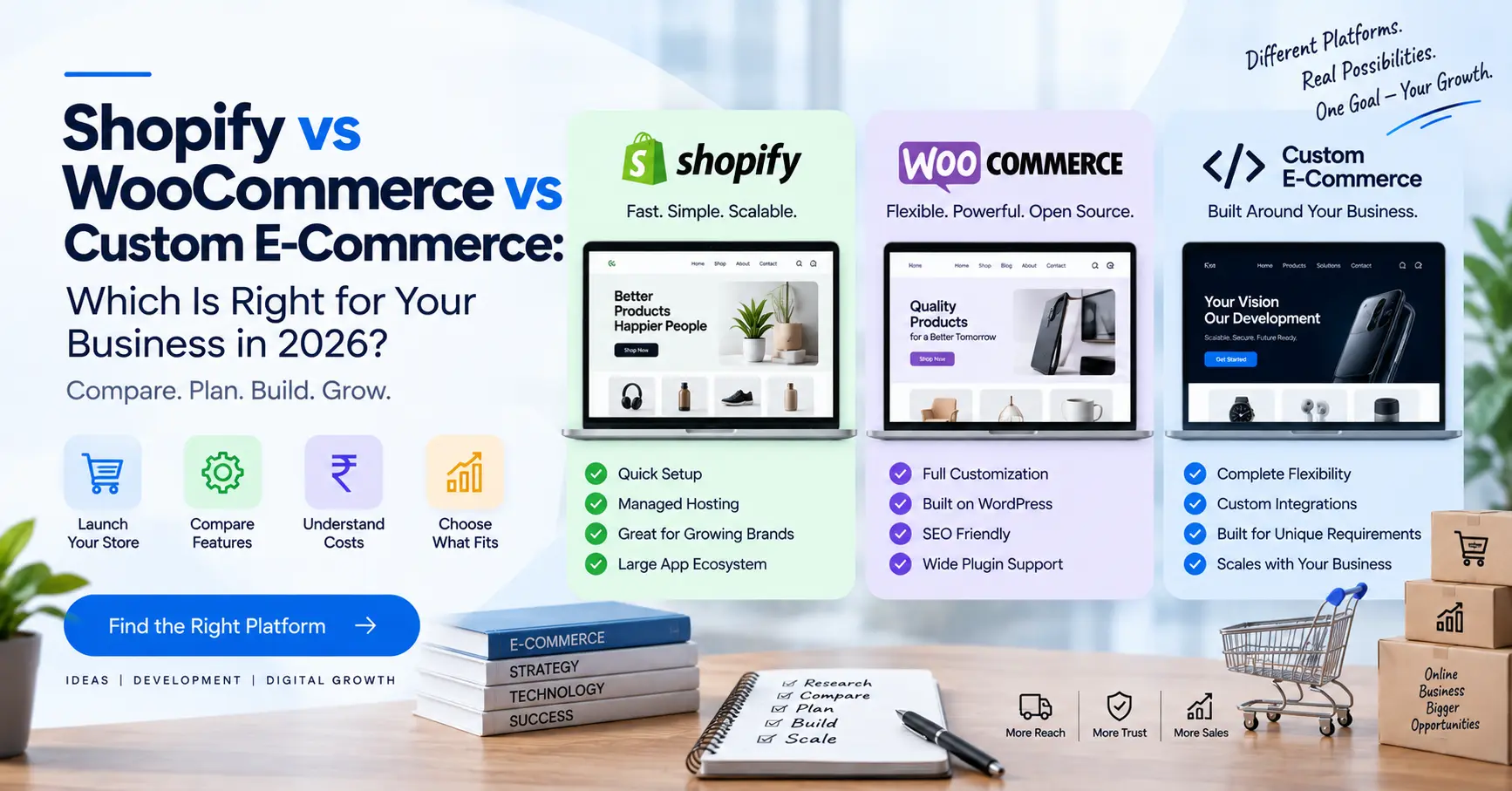
Shopify vs WooCommerce vs Custom E-Commerce Website: Which Is Right for Your Business in 2026?
Starting an online store is easier than it used to be.
The difficult part is choosing the right technology.
You may have already heard of Shopify and WooCommerce. You may also have considered building a completely custom e-commerce website using technologies such as React, Next.js, Laravel, or another development stack.
All three approaches can work.
But they solve different problems.
A small business selling a few dozen products does not necessarily need a custom e-commerce platform.
At the same time, a business with complex pricing, inventory, ERP integrations, multiple sellers, or custom workflows may eventually outgrow a standard platform.
So which should you choose?
This guide compares Shopify, WooCommerce, and custom e-commerce development based on cost, flexibility, SEO, ownership, performance, integrations, maintenance, and scalability.
Shopify vs WooCommerce vs Custom: Quick Comparison
| Factor | Shopify | WooCommerce | Custom E-Commerce |
|---|---|---|---|
| Setup speed | Fast | Moderate | Slowest |
| Initial complexity | Low | Medium | High |
| Customization | High | Very high | Highest |
| Hosting | Managed | You manage hosting | You manage infrastructure |
| Ownership | Platform-based | High | Highest |
| Plugin ecosystem | Large | Very large | Not applicable |
| SEO flexibility | Good | Very good | Depends on implementation |
| Custom business logic | Limited to platform capabilities | High with development | Highest |
| Maintenance | Lower technical burden | Requires ongoing maintenance | Requires development team |
| Best for | Fast-growing D2C brands | Flexible stores and content-led businesses | Complex business requirements |
There is no universal winner.
The correct choice depends on your business model and requirements.
What Is Shopify?
Shopify is a hosted e-commerce platform that provides the infrastructure needed to launch an online store.
You can use it to manage:
- Products
- Collections
- Customers
- Orders
- Payments
- Checkout
- Shipping
- Discounts
- Analytics
- Store design
One of Shopify's biggest advantages is simplicity.
You don't need to manage the underlying server infrastructure yourself.
This can make Shopify attractive for businesses that want to launch quickly without maintaining a large technical stack.
What Is WooCommerce?
WooCommerce is an open-source e-commerce platform built for WordPress.
It turns a WordPress website into an online store.
WooCommerce can handle:
- Products
- Categories
- Cart
- Checkout
- Orders
- Coupons
- Payments
- Shipping
- Customer accounts
- Product variations
Because it runs on WordPress, you also get access to a large ecosystem of themes and plugins.
WooCommerce can be particularly useful when content marketing and e-commerce need to work closely together.
What Is Custom E-Commerce Development?
A custom e-commerce website is developed around the specific requirements of a business instead of relying primarily on a pre-built store platform.
A custom solution may use technologies such as:
- React
- Next.js
- Node.js
- Laravel
- PostgreSQL
- Headless commerce platforms
- Custom APIs
The exact technology should depend on the project.
Custom development becomes more relevant when your business needs functionality that standard platforms cannot handle efficiently.
Examples include:
- Complex B2B pricing
- Dealer-specific pricing
- Custom inventory systems
- ERP integration
- POS integration
- Multiple warehouses
- Advanced product configurators
- Complex subscription logic
- Multi-vendor marketplaces
- Custom customer portals
Shopify: When Does It Make Sense?
Shopify can be a practical choice when your priority is getting an online store running without managing the technical infrastructure yourself.
It can be suitable for:
- New e-commerce businesses
- D2C brands
- Small and medium-sized stores
- Businesses with standard checkout requirements
- Businesses that want a faster launch
- Teams without dedicated developers
Shopify Advantages
Fast Launch
A standard Shopify store can generally be launched faster than a custom e-commerce application.
Managed Infrastructure
Shopify handles much of the underlying infrastructure.
This reduces the technical maintenance burden for the store owner.
Large App Ecosystem
Shopify has a large ecosystem of applications that can add functionality such as:
- Marketing
- Reviews
- Inventory
- Analytics
- Customer support
- Shipping
Easier Day-to-Day Management
Store owners can manage products and orders without needing to modify application code.
Shopify Limitations
Shopify is not infinitely flexible.
Your store operates within the platform's architecture.
You may eventually encounter limitations around:
- Custom business logic
- Checkout customization
- Complex integrations
- App dependency
- Recurring software costs
Before choosing Shopify, identify the features your business will actually need.
WooCommerce: When Does It Make Sense?
WooCommerce can be a strong option when you want more control over your website while still using a proven e-commerce platform.
It can be suitable for:
- Small and medium businesses
- Content-heavy brands
- Businesses already using WordPress
- Stores requiring extensive customization
- Businesses that want greater control over hosting
WooCommerce Advantages
Flexible Customization
Because WooCommerce runs on WordPress, developers can modify the site extensively.
Strong Content and SEO Foundation
WordPress is widely used for content publishing, making WooCommerce useful for businesses that combine:
Content + SEO + E-commerce.
Large Plugin Ecosystem
You can extend the store with plugins for:
- Payments
- Shipping
- SEO
- Marketing
- Product reviews
- Analytics
- Memberships
- Subscriptions
WooCommerce Limitations
More control also means more responsibility.
You may need to manage:
- Hosting
- WordPress updates
- Plugin updates
- Security
- Backups
- Performance
- Plugin compatibility
Poorly maintained WooCommerce websites can become slow or unstable.
The platform itself is not necessarily the problem.
The implementation and maintenance matter.
Custom E-Commerce: When Does It Make Sense?
Custom development becomes more attractive when your business model itself requires custom software.
For example, imagine a B2B business where:
- Every customer has a different price
- Products are connected to an ERP
- Inventory comes from multiple warehouses
- Customers have credit limits
- Orders require approval
- Different users have different permissions
Trying to force all of that into a collection of plugins can create unnecessary complexity.
A custom application may make more sense.
Custom Development Advantages
Maximum Flexibility
The software can be designed around your business process.
Custom Integrations
You can build APIs and integrations around:
- ERP
- CRM
- POS
- Inventory
- Logistics
- Accounting
- Payment systems
Greater Control
You control the application architecture and business logic.
Scalability
A properly engineered system can be designed around expected traffic and business requirements.
Custom Development Disadvantages
Custom development also introduces responsibility.
You need to budget for:
- Development
- Testing
- Hosting
- Security
- Maintenance
- Bug fixes
- Feature development
- Monitoring
A custom platform is software.
It is not a one-time website purchase.
Shopify vs WooCommerce: Which Is Better?
There is no universal answer.
Instead, compare the requirements.
Choose Shopify if:
- You want a faster launch
- You prefer managed infrastructure
- Your requirements are relatively standard
- You want easier store administration
- You are comfortable with recurring platform and app costs
Choose WooCommerce if:
- You want more control over your website
- You already use WordPress
- Content and SEO are important
- You need extensive customization
- You are comfortable managing hosting and maintenance
Shopify vs Custom E-Commerce
The difference is mainly about standardization versus control.
Shopify provides a mature e-commerce environment.
Custom development gives you more freedom to design the system around your business.
Ask:
Does my business have standard e-commerce requirements?
If yes, a platform may be enough.
Ask:
Is my business process itself difficult to represent using standard e-commerce functionality?
If yes, custom development deserves consideration.
WooCommerce vs Custom E-Commerce
WooCommerce can be highly customizable.
But there is a difference between customizing a platform and building an application from scratch.
WooCommerce may be enough when your business requirements can be handled reliably through:
- Existing functionality
- Plugins
- Custom development
- APIs
Custom development becomes more relevant when those approaches create too many compromises.
Which Is Better for SEO?
All three can support SEO.
The platform does not automatically determine whether a store will rank well.
SEO depends on implementation and content.
Important e-commerce SEO areas include:
- Product titles
- Product descriptions
- Category pages
- Internal linking
- Technical SEO
- Page speed
- Mobile experience
- Structured data
- Canonical URLs
- Indexation
- Image optimization
- Search intent
Google provides specific documentation for Product structured data and merchant listing experiences. Adding appropriate Product markup can make product pages eligible for certain enhanced search experiences, subject to Google's requirements.
Learn about Google's Product structured data
E-Commerce SEO Needs More Than Product Pages
A common mistake is expecting product pages to generate all organic traffic.
An e-commerce website can also create useful content around customer questions.
For example:
- Buying guides
- Product comparisons
- How-to guides
- Product use cases
- FAQs
- Industry guides
- Troubleshooting content
This can help capture informational searches before customers are ready to purchase.
Your website should connect informational content to relevant product and category pages.
What About Website Cost?
The cost difference between Shopify, WooCommerce, and custom development can be substantial.
But the cheapest initial build does not necessarily produce the lowest total cost.
You should consider:
- Development
- Platform subscriptions
- Hosting
- Plugins
- Apps
- Payment processing
- Maintenance
- Security
- Custom integrations
- Content
- SEO
- Future development
For a broader breakdown of Indian website pricing, see:
How Much Does a Website Cost in India in 2026?
And if you specifically want to understand e-commerce budgets, compare the total requirements rather than simply asking for a "complete e-commerce website."
Don't Build Custom Just Because You Can
This is one of the most expensive mistakes businesses can make.
Custom development sounds attractive because it offers maximum flexibility.
But flexibility has a cost.
If Shopify or WooCommerce already solves 90% of your requirements, rebuilding those same capabilities from scratch may not create enough business value to justify the additional development and maintenance.
Custom development should solve a real business problem.
It should not exist simply because custom technology sounds more professional.
Don't Choose Shopify or WooCommerce Just Because They're Cheap
The opposite mistake is also common.
A platform can be inexpensive to start but become expensive when you add:
- Paid apps
- Custom development
- Premium themes
- Integrations
- Additional services
- Migration work
Look at the total cost of ownership rather than only the initial setup price.
Think About Your Product Catalogue
Your catalogue size can influence the architecture.
A store selling:
20 products
has different requirements from one managing:
20,000 products.
Consider:
- Number of products
- Variations
- Categories
- Product attributes
- Inventory sources
- Search
- Filtering
- Bulk imports
- Product updates
Catalogue complexity can matter more than the number of pages.
Think About Payments and Shipping
Indian e-commerce businesses may need to consider:
- Online payments
- Cash on delivery
- Shipping zones
- Pincode serviceability
- Order tracking
- Returns
- Refunds
- Tax calculation
- Invoice generation
These requirements should be defined before choosing a platform.
Do not assume that "payment gateway integration" means every payment and settlement workflow your business needs has already been solved.
Think About Future Growth
You don't need to build for a hypothetical billion-dollar business on day one.
But you should avoid creating a system that becomes impossible to extend.
Ask:
- What happens if the catalogue doubles?
- What happens if traffic increases?
- What happens if we add new payment methods?
- What happens if we need an ERP?
- What happens if we add a mobile app?
- What happens if we expand internationally?
- What happens if we introduce subscriptions?
Your technology should leave a sensible path for growth.
A Practical Decision Framework
Use this simple framework.
Choose Shopify when:
Speed + simplicity + standard e-commerce are your priorities.
Choose WooCommerce when:
Control + content + customization are your priorities.
Choose custom development when:
Business-specific functionality + integrations + control are your priorities.
The important word is requirements.
Do not select a technology first and then try to force your business into it.
Define the business requirements first.
Questions to Ask Before Starting an E-Commerce Project
Before hiring an e-commerce developer, define:
- How many products will you sell?
- How many product variations exist?
- Which payment methods are required?
- Do you need COD?
- Which shipping providers will you use?
- Do you need GST invoices?
- Do you need inventory synchronization?
- Do you need ERP integration?
- Do customers need accounts?
- Do you need subscriptions?
- Do you need a mobile app?
- Who will manage products?
- Who will manage the website?
- What SEO functionality is required?
- What happens after launch?
The answers to these questions will make the platform decision much easier.
Final Thoughts
Shopify, WooCommerce, and custom e-commerce development are not simply three competing technologies.
They represent three different approaches to building an online store.
Shopify prioritizes a managed platform and faster setup.
WooCommerce provides a flexible WordPress-based e-commerce environment.
Custom development provides the greatest control when your business requires custom workflows and integrations.
The right decision depends on your:
- Business model
- Product catalogue
- Budget
- Technical requirements
- Marketing strategy
- Growth plans
- Integration requirements
Don't choose a platform because someone says it is "the best."
Choose the platform that solves your actual business requirements without creating unnecessary complexity.
If you are planning an e-commerce website, Arctis Digital can help you evaluate the requirements, choose an appropriate approach, and build an online store around your business goals.