
E-Commerce SEO in India: How to Get Your Products Found on Google in 2026
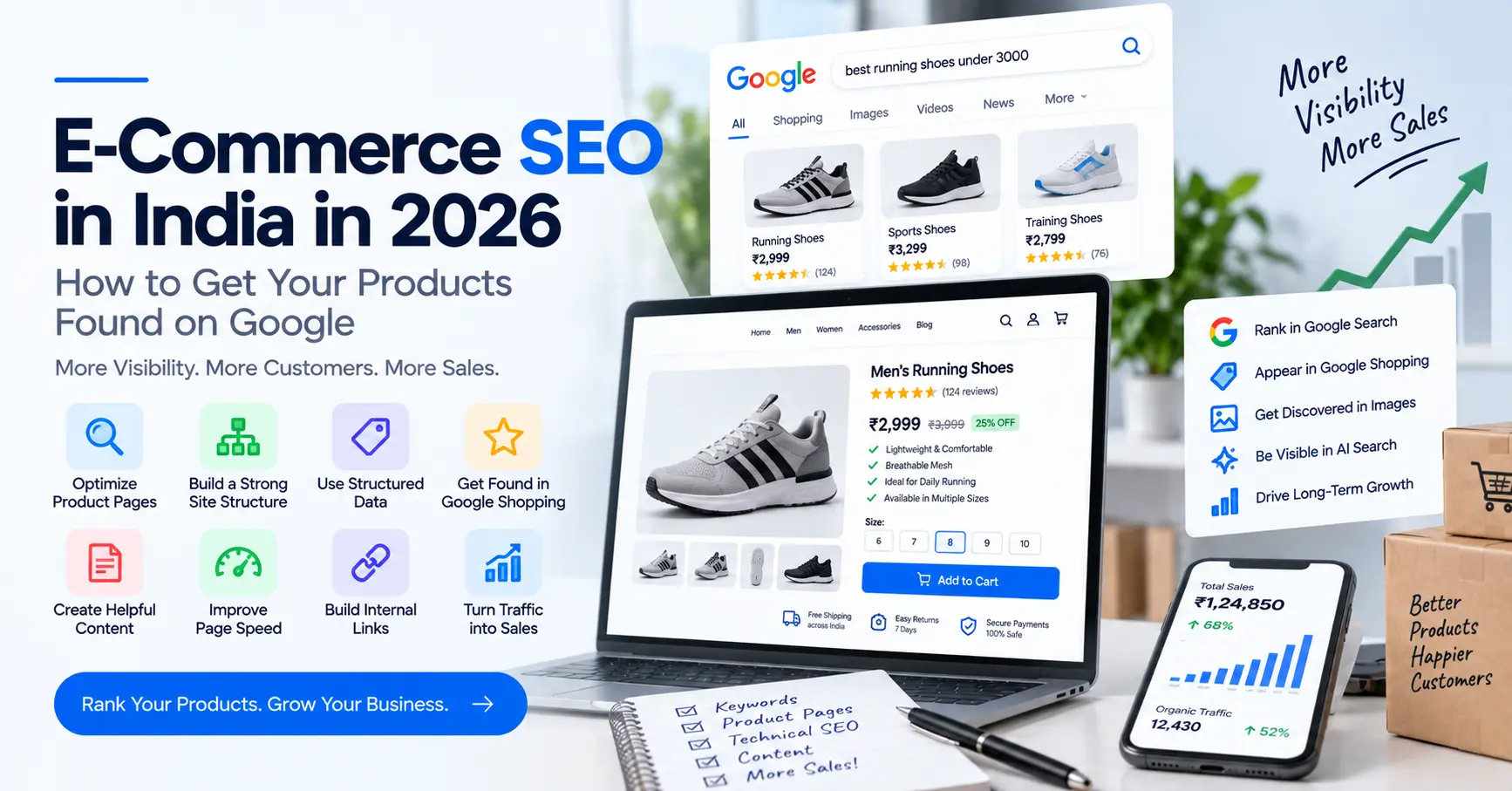
E-Commerce SEO in India: How to Get Your Products Found on Google in 2026
Launching an e-commerce website is only the beginning.
Your products may be excellent, your website may look professional, and your checkout process may work perfectly—but if customers cannot discover your products through Google, you may still struggle to generate organic traffic and sales.
This is where e-commerce SEO becomes important.
E-commerce SEO is the process of optimizing your online store, product pages, category pages, content, technical structure, and product information so search engines can better discover, understand, and surface your products.
In 2026, e-commerce SEO is no longer only about adding keywords to product descriptions.
Your website also needs:
- Clear product and category structure
- Crawlable internal links
- Helpful product information
- Fast and mobile-friendly pages
- Product structured data
- Google Merchant Center integration
- High-quality product images
- Useful category content
- Strong internal linking
- Trust signals and customer information
- Content that can be understood across traditional and AI-powered search
This guide explains how businesses in India can build a stronger e-commerce SEO strategy in 2026.
What Is E-Commerce SEO?
E-commerce SEO is the practice of improving an online store so that its products, categories, and other useful pages can be discovered through search engines.
For example, imagine you sell:
- Running shoes
- Office chairs
- Skincare products
- Mobile accessories
- Home decor
- Clothing
- Electronics
Instead of relying entirely on paid advertising, SEO can help your products appear when people search for relevant products or questions.
Someone might search for:
"best running shoes under ₹3000"
Another person might search for:
"buy ergonomic office chair online"
Another might search:
"waterproof trekking shoes for men"
These searches represent different stages of the buying journey.
A good e-commerce SEO strategy connects your products and content with these search intents.
Why E-Commerce SEO Matters in 2026
Google provides multiple ways for e-commerce content to appear across its ecosystem, including Search, Google Images, and Google Lens.
Google also supports product-related structured data and product information through Merchant Center, which can help eligible products appear in richer shopping experiences.
However, SEO is not simply about adding schema and expecting your products to rank.
Your website still needs useful content, good site structure, crawlable pages, and a strong user experience.
Google's current guidance also states that the fundamental SEO practices remain relevant for AI-powered search features such as AI Overviews and AI Mode.
So the goal should not be to create a separate "AI SEO website."
The goal should be to build a genuinely useful e-commerce website that search engines can understand.
1. Start With Search Intent
One of the biggest mistakes e-commerce websites make is treating every keyword the same way.
Someone searching:
"Nike running shoes"
has a different intent from someone searching:
"best running shoes for beginners"
And both are different from:
"how to choose running shoes"
These searches can require different pages.
A simple search-intent structure
| Search Intent | Example | Suitable Page |
|---|---|---|
| Transactional | Buy running shoes online | Product/category page |
| Commercial | Best running shoes under ₹3000 | Category/content page |
| Informational | How to choose running shoes | Blog/guide |
| Navigational | BrandName running shoes | Brand/category page |
| Local | Running shoes store in Vadodara | Local/business page |
Your SEO strategy should connect the right search intent with the right page.
2. Optimize Your Product Pages
Your product page is one of the most important pages on an e-commerce website.
A weak product page might contain:
- Product name
- One image
- Price
- "Buy Now"
That may not provide enough useful information for shoppers or search engines.
A stronger product page can include:
- Clear product title
- Detailed description
- Product specifications
- Multiple product images
- Price
- Availability
- Variants
- Size information
- Shipping information
- Return policy
- FAQs
- Genuine customer reviews
- Related products
- Product structured data
The objective is to answer the questions a potential customer has before purchasing.
3. Write Better Product Titles
Your product title should clearly communicate what the product is.
Instead of:
"Premium Shoes"
Use something more descriptive, such as:
"Men's Lightweight Running Shoes for Road Running"
The title should describe the actual product rather than attempting to insert every possible keyword.
Avoid keyword stuffing such as:
"Running Shoes Men's Shoes Sports Shoes Best Running Shoes Buy Running Shoes Online Cheap Running Shoes"
That makes the page harder to read and does not create a better shopping experience.
4. Write Product Descriptions for Customers First
A product description should help someone decide whether the product is appropriate for them.
For example, instead of:
"High-quality premium chair with modern design."
Explain:
- Maximum weight capacity
- Material
- Dimensions
- Adjustable features
- Suitable use cases
- Warranty
- Assembly requirements
- Delivery information
The more useful information you provide, the easier it becomes for customers to make a decision.
Google's guidance emphasizes useful, people-first content rather than content created primarily to manipulate search rankings.
5. Build Strong Category Pages
Don't focus all your SEO efforts on individual products.
Category pages can also be important landing pages.
For example:
Home
│
├── Men's Clothing
│   ├── Shirts
│   ├── T-Shirts
│   └── Jeans
│
├── Women's Clothing
│   ├── Dresses
│   ├── Tops
│   └── Jeans
│
└── Accessories
    ├── Watches
    ├── Bags
    └── Sunglasses
A good category page should help users understand:
- What products are available
- Who they are for
- How products differ
- What filters are available
- What buying considerations matter
You can also add useful introductory content to important category pages.
6. Create a Logical E-Commerce Site Structure
Google analyzes the relationships between pages through their links.
A simple structure might look like:
Homepage
   ↓
Category
   ↓
Subcategory
   ↓
Product
For example:
Home
→ Shoes
→ Running Shoes
→ Men's Running Shoes
→ Product
This makes it easier for users and search engines to navigate your store.
Google recommends making important products reachable through normal crawlable links rather than relying entirely on internal search functionality.
If Google cannot discover a product through your site's navigation or links, that product may be harder to crawl.
7. Use Internal Links Strategically
Internal links connect pages within your website.
For example:
Looking for more options? Explore our men's running shoes.
You can link:
- Blog posts → Category pages
- Blog posts → Product pages
- Category pages → Product pages
- Product pages → Related products
- Products → Relevant categories
- Guides → Products
Internal linking isn't only about SEO.
It also helps customers discover relevant products.
Google recommends using meaningful link text and crawlable links rather than generic phrases such as "click here."
8. Optimize Product Images
Images are extremely important for e-commerce websites.
Customers want to see the product before purchasing it.
Optimize images by using:
- High-quality product photography
- Multiple product angles
- Descriptive file names
- Useful alt text
- Appropriate image dimensions
- Modern image formats where suitable
- Compressed files
- Mobile-friendly images
For example:
Bad file name:
IMG_4837.jpg
Better:
black-leather-office-chair.jpg
Alt text should describe the image naturally.
For example:
Black ergonomic leather office chair with adjustable headrest
Don't use alt text as a place to insert a list of keywords.
9. Add Product Structured Data
Structured data helps Google understand specific information on your pages.
For e-commerce websites, Product structured data can communicate information such as:
- Product name
- Image
- Price
- Availability
- Brand
- Reviews
- Offers
- Shipping information
- Return information
Google says eligible product pages can potentially appear in richer merchant listing experiences when the required information and guidelines are satisfied.
However, structured data does not guarantee that Google will show a rich result.
It simply makes the information easier for Google to understand and can make the page eligible for certain search experiences.
Official documentation:
Google Product Structured Data
Google Merchant Listing Structured Data
10. Connect Your Store With Google Merchant Center
Google Merchant Center allows businesses to provide product data directly to Google.
Your product feed can contain information such as:
- Product title
- Description
- Price
- Availability
- Product URL
- Image
- Brand
- Product identifiers
Google recommends sharing product data through Merchant Center and using structured data on product pages where feasible.
Using both can help Google understand and verify your product information.
For e-commerce businesses, Merchant Center should therefore be considered as part of the broader search strategy rather than treating SEO and product feeds as completely separate activities.
11. Don't Ignore Technical SEO
A beautiful online store can still have SEO problems.
Important technical areas include:
- HTTPS
- Mobile usability
- Page performance
- Crawlability
- Indexability
- Canonical URLs
- XML sitemap
- Robots.txt
- Duplicate pages
- Broken links
- Redirects
- Product variants
- Pagination
- Faceted navigation
E-commerce websites can create thousands of URLs through filters and sorting.
For example:
/shoes
/shoes?size=9
/shoes?color=black
/shoes?brand=nike
/shoes?size=9&color=black
If handled poorly, these URL variations can create crawling and indexing problems.
Technical SEO should therefore be considered during development—not added as an afterthought.
12. Be Careful With Product Variants
Products often have variants such as:
- Size
- Color
- Storage
- Material
- Pack size
For example:
/tshirt
/tshirt?color=black
/tshirt?color=blue
/tshirt?size=large
Your implementation should clearly communicate the relationship between variants.
Google's e-commerce documentation provides specific recommendations for product variant URLs and canonicalization.
This becomes especially important for stores with hundreds or thousands of product variations.
13. Create Content Around Buying Questions
Your blog should not exist only to publish random articles.
Use content to answer questions potential customers ask before buying.
For example, if you sell laptops, you could create:
Buying guides
- Best laptops for students
- Laptop buying guide for developers
- 8GB vs 16GB RAM
- SSD vs HDD
- How much RAM do you need?
Comparisons
- MacBook vs Windows laptop
- OLED vs IPS display
- Intel vs AMD processors
Product education
- How to clean a laptop screen
- How to improve laptop battery life
- How to choose the right laptop size
These articles can internally link to relevant product and category pages.
14. Build Topic Clusters
Instead of publishing unrelated blog posts, build groups of content around important product categories.
For example:
                Laptop Buying Guide
                       │
        ┌──────────────┼──────────────┐
        ↓              ↓              ↓
   Best Laptops    RAM Guide      SSD Guide
        │              │              │
        └──────────────┼──────────────┘
                       ↓
                 Laptop Category
                       ↓
                  Product Pages
This creates a logical connection between informational content and commercial pages.
15. Optimize for AI-Powered Search Without Chasing "AI SEO Hacks"
Search is becoming more conversational.
Customers may ask:
"Which laptop should I buy for coding under ₹70,000?"
Instead of:
"best laptop"
Your content should therefore answer complete questions clearly.
Useful formats include:
- Direct answers
- Comparison tables
- Buying guides
- FAQs
- Product specifications
- Pros and cons
- Use-case explanations
- Clear definitions
But don't create content simply because you think an AI system might quote it.
Google's current guidance says there are no special technical requirements or special markup needed specifically to appear in AI Overviews or AI Mode.
The same fundamental SEO principles still matter:
- Helpful content
- Technical accessibility
- Internal links
- Textual information
- Good page experience
- Accurate structured data
16. Build Trust Before Asking for the Sale
People are often hesitant to buy from an unfamiliar online store.
Your website should make important information easy to find.
Consider providing:
- About Us page
- Contact information
- Business details
- Shipping policy
- Return policy
- Refund policy
- Privacy policy
- Terms and conditions
- Warranty information
- Customer support options
- Secure payment options
- Genuine reviews
Don't manufacture reviews or claims.
Trust should come from real information and genuine customer experiences.
17. Don't Create Hundreds of Low-Quality Product Pages
More indexed pages do not automatically mean more organic traffic.
Suppose an online store creates thousands of pages with:
- Nearly identical descriptions
- No unique information
- Very little product detail
- Automatically generated text
- No meaningful customer value
That creates a large website—but not necessarily a useful one.
Focus on making important product and category pages genuinely valuable.
A smaller catalogue with strong pages can be more useful than thousands of thin pages.
18. Improve Your Product Page Experience
SEO and conversion optimization should work together.
A product page should make it easy to understand:
What is it?
How much does it cost?
Is it available?
When will it arrive?
Can I return it?
Is it suitable for me?
Why should I trust this store?
Important information should not be hidden behind unnecessary clicks.
Also test your website on mobile devices because a large portion of online shopping activity happens on smartphones.
19. Measure Your E-Commerce SEO
Don't judge SEO only by rankings.
Track multiple metrics.
Organic traffic
Are search visitors increasing?
Product impressions
Are more products appearing in search?
Click-through rate
Are users clicking your search results?
Conversions
Are organic visitors actually purchasing?
Revenue from organic search
Is SEO contributing to business revenue?
Indexed pages
Are important product and category pages being indexed?
Search queries
What terms are bringing visitors to your website?
Google Search Console can help you monitor search performance and identify opportunities.
For product structured data, Search Console also provides relevant reports that can help identify errors and warnings.
20. E-Commerce SEO Checklist for 2026
Before launching or improving your online store, check the following.
Product Pages
- Unique product titles
- Useful product descriptions
- High-quality images
- Descriptive image alt text
- Price and availability
- Product variants
- Customer reviews
- Shipping information
- Return information
Technical SEO
- HTTPS enabled
- Mobile-friendly design
- Fast page loading
- XML sitemap
- Robots.txt configured
- Canonical URLs
- No important broken links
- Correct redirects
- Proper handling of filters
Search Visibility
- Google Search Console configured
- Google Merchant Center configured
- Product structured data implemented
- Product URLs are crawlable
- Category pages link to products
- Important products receive internal links
Content
- Buying guides
- Product comparisons
- FAQs
- Category content
- Helpful blog articles
- Internal links between related content
Trust
- About page
- Contact information
- Shipping policy
- Return/refund policy
- Privacy policy
- Terms and conditions
- Genuine customer reviews
E-Commerce SEO vs Paid Advertising
SEO and paid advertising serve different purposes.
Paid advertising can provide traffic while a campaign is active.
SEO focuses on building organic visibility over time.
For many e-commerce businesses, combining both can make sense.
For example:
Paid Ads
   ↓
Immediate Traffic
   ↓
Sales + Data
while:
SEO
   ↓
Organic Visibility
   ↓
Product Discovery
   ↓
Long-Term Traffic
The exact mix depends on your products, margins, competition, customer acquisition costs, and business goals.
How Much Does E-Commerce SEO Cost in India?
There is no single price for e-commerce SEO.
The cost depends on factors such as:
- Number of products
- Number of categories
- Website platform
- Technical complexity
- Competition
- Content requirements
- Link-building requirements
- Local vs national targeting
- Existing website authority
- Monthly SEO work required
A small store with 50 products has very different SEO requirements from a marketplace with 50,000 products.
Instead of asking only:
"How much does SEO cost?"
ask:
"What needs to be improved on my website to reach my target customers?"
That gives you a much more useful starting point.
Common E-Commerce SEO Mistakes
Avoid these common problems:
Keyword stuffing
Using the same keyword repeatedly does not make a page better.
Duplicate product descriptions
Copying manufacturer descriptions across every store makes it difficult to differentiate your pages.
Ignoring category pages
Important category pages can be valuable search landing pages.
Blocking important products
If search engines cannot crawl important product pages, they may struggle to discover them.
Ignoring images
Poor images can hurt both user experience and image-based discovery.
Creating unnecessary URLs
Filters and sorting can generate huge numbers of URLs if not handled carefully.
Buying low-quality backlinks
Large numbers of irrelevant or manipulative links are not a substitute for useful content and a strong website.
Focusing only on rankings
A ranking without clicks, customers, or revenue is not the final business objective.
A Practical E-Commerce SEO Strategy for an Indian Business
If you're starting from scratch, don't try to optimize everything simultaneously.
Use this sequence.
Step 1: Fix the website structure
Make categories, subcategories, and products logically connected.
Step 2: Optimize your most important products
Start with your best-selling or highest-margin products.
Step 3: Improve category pages
Make them useful for customers and search engines.
Step 4: Implement technical SEO
Fix crawling, indexing, canonicalization, speed, and mobile issues.
Step 5: Implement product structured data
Make sure the structured data accurately represents visible product information.
Step 6: Connect Google Merchant Center
Provide accurate product data to Google.
Step 7: Publish useful content
Create buying guides, comparisons, FAQs, and educational content.
Step 8: Build internal links
Connect blogs, categories, and products naturally.
Step 9: Monitor Search Console
Look for queries, indexing problems, impressions, clicks, and opportunities.
Step 10: Improve based on actual data
SEO should become an ongoing process rather than a one-time website task.
Final Thoughts
E-commerce SEO in 2026 is not about finding one secret keyword or installing one SEO plugin.
It is about building a store that is:
- Easy for customers to navigate
- Easy for search engines to crawl
- Clear about its products
- Helpful during the buying process
- Technically accessible
- Structured correctly
- Supported by useful content
- Connected to relevant Google commerce systems
If your store is built on Shopify, WooCommerce, or a custom technology stack, the implementation will be different—but the underlying SEO principles remain similar.
If you're still deciding which e-commerce platform to use, read our guide:
Shopify vs WooCommerce vs Custom E-Commerce Website: Which Is Right for Your Business in 2026?
You can also compare the broader cost of building an online store in our guide:
How Much Does a Website Cost in India in 2026?
For businesses considering a complete website or a focused landing page, see:
Website vs Landing Page: Which Does Your Business Need in 2026?
And if your business also depends on local customers, our local SEO guide can help:
How to Rank Your Business on Google Maps in 2026
Useful Official Resources
- Google Search Central: E-commerce SEO Best Practices
- Google Search Central: E-commerce Site Structure
- Google Search Central: Product Structured Data
- Google Search Central: Merchant Listing Structured Data
- Google Search Central: AI Features and Your Website
- Google Merchant Center
Need Help With E-Commerce SEO?
A technically strong e-commerce website gives your products a better foundation for organic discovery.
Arctis Digital can help businesses with:
- E-commerce website development
- Shopify and WooCommerce development
- Custom e-commerce solutions
- SEO
- Technical SEO
- Product and category optimization
- Website performance
- Google integrations
- Digital marketing
The right strategy depends on your products, customers, competition, and business goals.
### Why this one fits your cluster

Your content cluster now becomes:

**1. Google + AI Search**
↓
**2. Website Cost in India**
↓
**3. Google Maps / Local SEO**
↓
**4. Website vs Landing Page**
↓
**5. Choosing a Website Development Company**
↓
**6. Shopify vs WooCommerce vs Custom E-Commerce**
↓
**7. E-Commerce SEO in India** ← **this article**

That gives you a much stronger topical relationship instead of seven disconnected blog posts.

For Blog 7, I would also make **Blog 6 link into this article**, because someone reading the platform-comparison article is naturally going to ask, *“Okay, but how do I actually get my store/products found?”*

Google specifically recommends crawlable internal linking and a logical ecommerce hierarchy, so this internal-link structure is useful for both users and search engines. :contentReference[oaicite:1]{index=1}

### Incoming links to add

From **Blog 6**:

> For more information about getting your products discovered through organic search, see our [E-Commerce SEO guide](../ecommerce-seo-india-2026).

From **Blog 2**:

> If you're planning an online store, our [E-Commerce SEO guide](../ecommerce-seo-india-2026) explains the SEO and technical considerations that affect e-commerce websites.

From **Blog 1**:

> E-commerce businesses should also understand how [E-Commerce SEO](../ecommerce-seo-india-2026) works across traditional and AI-powered search.

### External authority

The strongest external links in this article are deliberately **Google's own documentation**, rather than random SEO blogs. Google currently recommends product structured data and Merchant Center product data for helping Google understand ecommerce products, while its AI-search guidance says there isn't a separate set of "AI SEO" technical requirements. :contentReference[oaicite:2]{index=2}

**Next after this:** I would move into a more commercial/local topic rather than another generic SEO article—something around **“How Much Does E-Commerce Website Development Cost in India in 2026?”** That can target high-intent visitors and connect directly to your e-commerce development service.